

In France, the technical specification (CCTP) is a mandatory contractual document for local authorities and other bodies subject to public procurement rules.
At a glance
The technical specification is the foundation of any multi-technical maintenance contract between the client and the contractor.
With the growth of multi-technical maintenance contracts in France and across Europe, private companies increasingly turn to engineering consultancies to draw up their technical specification.
In short, a maintenance specification has five benefits:
- it defines the scope of services and the expected deliverables;
- it sets out each party’s rights and obligations;
- it gives the contractor the technical information it needs (equipment list, maintenance routines, technical constraints, client requirements);
- it tells the contractor what level and quality of service is expected;
- it provides all the means needed to deliver the services properly.
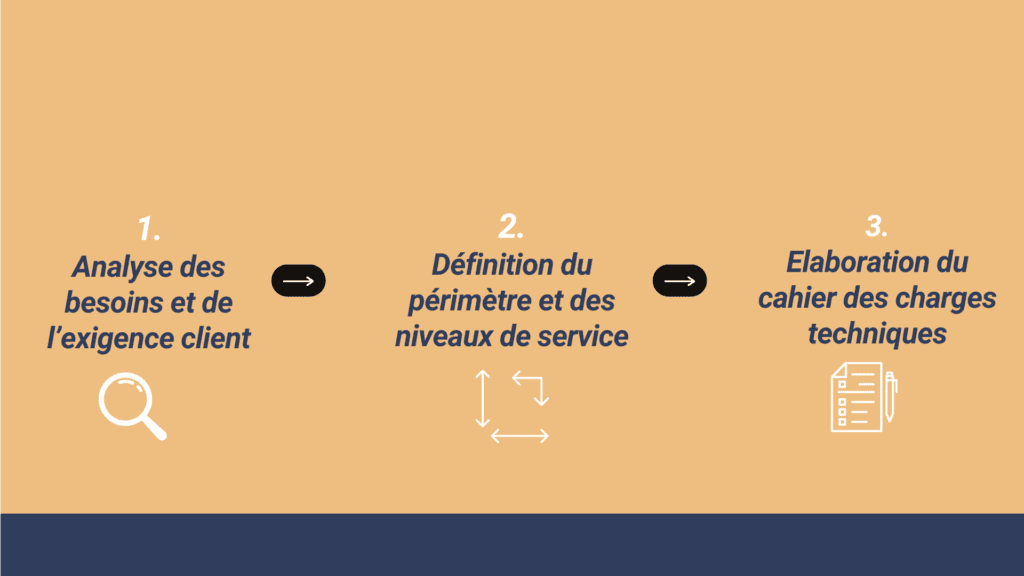
A specification first requires upstream work: analysing the client’s needs, the constraints of the site to be maintained and the regulations in force. The scope and service levels are then defined on that basis.
If you are planning a technical specification for your maintenance contracts, contact us at contact@lunaar.io.
LUNAAR is a consulting, audit and owner’s advisory firm specialising in multi-technical maintenance for commercial buildings.
What the specification should contain
Many of the difficulties in a multi-technical maintenance contract come from the specification. If it is vague, each contractor reads it their own way: offers can no longer be compared, and the gaps come back later as extra work. These are the points we check before launching a tender.
1. An up-to-date equipment inventory
This is the basis for pricing. For each trade, the inventory gives at least the location, type of equipment, make, power or capacity, year of commissioning and visible condition. Without this information, contractors price on assumptions and protect themselves: a safety margin in the fixed fee, or exclusions that come back later as quotes.
If the existing inventory is several years old, it is better to update it before the tender, or at least to require bidders to visit the site.
2. A clear scope, trade by trade
The specification lists the technical trades covered: HVAC, plumbing, high- and low-voltage electrical systems, fire safety, BMS and other equipment. It also states what is excluded. Lifts, automatic doors or statutory inspections are sometimes covered by separate contracts: this needs to be written down, otherwise everyone assumes whatever suits them.
3. Preventive maintenance routines
For each family of equipment, the document sets the expected tasks and their frequency. Frequencies are based on regulatory obligations and manufacturers’ recommendations, then adjusted to how the building is used. Bidders can be asked to propose their own routines, but comparing offers then becomes much harder.
4. The boundary between P2 and P3
In French contracts, P2 covers routine maintenance and P3 covers major servicing and replacement. The specification must settle the boundary: up to what amount is a part included in the fixed fee? Who decides to replace end-of-life equipment? How is the replacement priced? A blurred boundary is a frequent source of disputes over extra work.
5. Response times by level of urgency
A single response time is not enough. A distinction is usually made between emergencies (safety of occupants, failure of a critical installation), priority breakdowns and routine requests, each with a response time and a repair time. The on-call service, its hours and how it is triggered are described separately.
6. A few simple indicators and proportionate penalties
Three or four well-chosen indicators are better than a twenty-line table nobody will follow: preventive completion rate, compliance with response times, availability of critical equipment, quality of reporting. Penalties are tied to these indicators, proportionate and capped. Too heavy, they end up in the price; too light, they are useless.
7. Reporting and the CMMS
The building owner must be able to check what is done. The specification sets the content of monthly reports, access to the contractor’s CMMS, the safety register and how often steering meetings take place. At the end of the contract, the inventory and the history of work orders must be handed back in a usable format.
8. A comparable price framework
A lump-sum price breakdown (DPGF in French public procurement) by trade and by site allows offers to be compared line by line. A schedule of unit rates (BPU) frames extra work: hourly rates, mark-ups on supplies, night and weekend surcharges. The price revision formula and its reference index are set from the start.
9. Start-up and exit
The specification organises the takeover of installations: joint site inspection, list of reservations, deadline to report existing defects. It also plans the exit: notice period, return of documents and data, handover to the next contractor. These clauses seem secondary during the tender. They matter a great deal three or five years later.
Before launching the tender
A good specification does not try to foresee everything. It gives every bidder the same information, sets rules on the points that usually cause disputes and allows offers to be compared on a common basis. This is the work we do in our maintenance tender assignments, often after an audit of the existing set-up.
Sources

 Tel :
 Email :